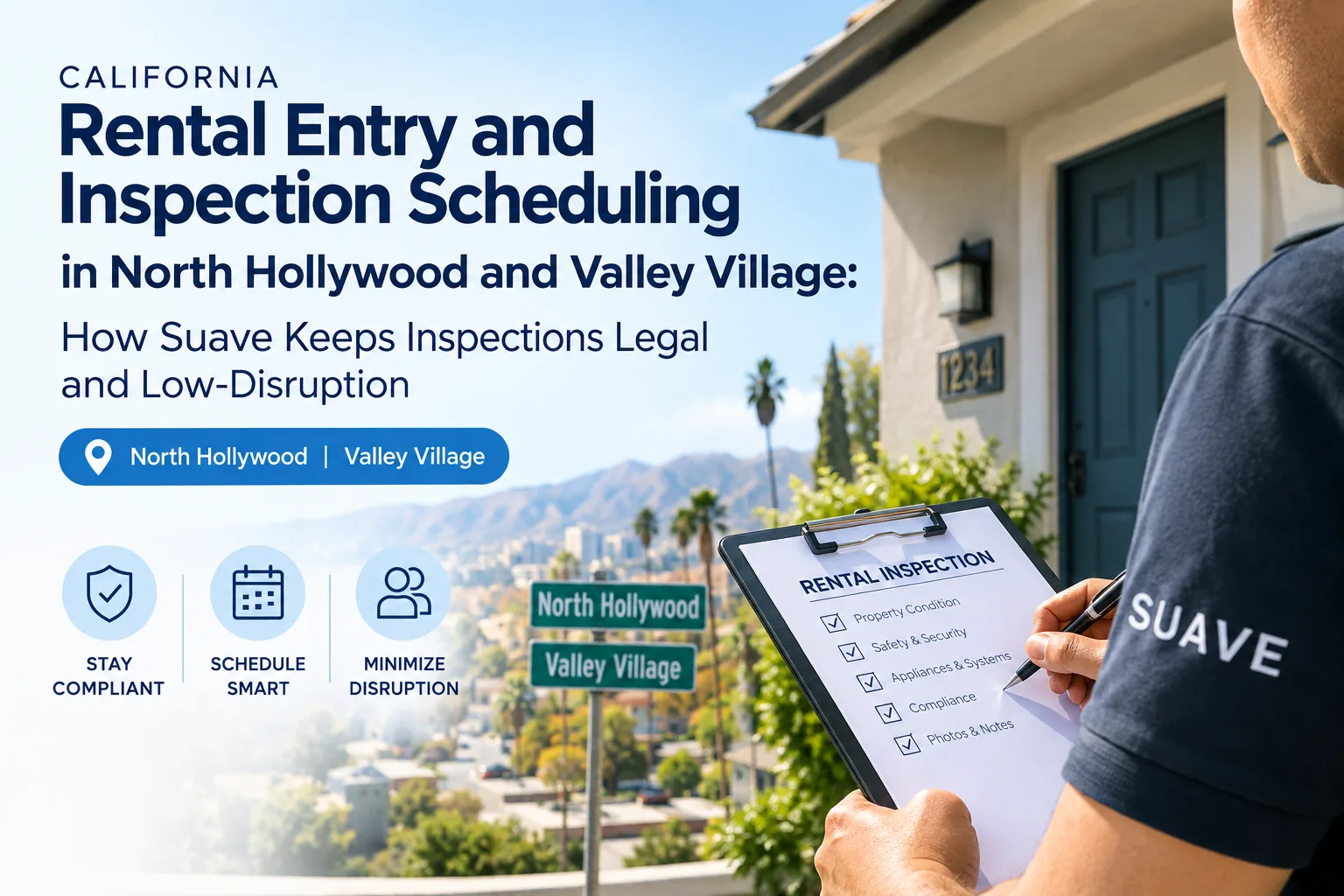
At Suave Management, we manage rentals across Los Angeles and the San Fernando Valley, including North Hollywood and Valley Village. A big part of staying compliant and keeping relationships strong is doing tenant entry and inspections the right way, with clear scheduling and good documentation.
This guide explains how we separate emergencies from routine inspections, how California notice rules work, and how tenants can request alternative times while preserving the landlord’s access rights.
1) Entry categories in California, and what each one requires
California law limits landlord access to specific purposes. In practice, we plan every visit by first identifying which category it falls under.
Emergencies, no-notice situations
- Examples include active water intrusion, electrical hazards, or other conditions that create immediate safety or property-damage risk.
- No advance written notice is required when responding to an emergency. The priority is to stabilize the situation.
Even for emergencies, we still communicate quickly with the tenant and document what happened.
Routine inspections and “reason-based” entries
- Routine entry should not be treated as “we want to look around.” The visit should align with an allowed legal purpose, such as inspecting conditions relevant to habitability, safety, or required compliance.
- For non-emergency entry, written notice is generally required.
Maintenance entry and agreed repairs
- Maintenance entry is typically handled with written notice when repairs need access to the unit.
- Sometimes an oral agreement to enter for agreed repairs is allowed if the agreement includes the date and approximate time and entry happens within a specified timeframe.
Our goal is to get maintenance done without repeated missed appointments.
2) Notice timing and what the written notice must include
For non-emergency entry, California Civil Code 1954 generally requires reasonable advance written notice. Twenty-four hours is presumed reasonable in most situations.
Your notice should state:
- The date
- The approximate time
- The purpose of entry
Also, California law requires entry only during normal business hours unless the tenant consents to a different time at the time of entry.
Our notices are designed to be easy for renters to read, easy for owners to verify, and consistent with the statute.
3) How Suave schedules inspection windows to reduce missed appointments
In North Hollywood and Valley Village, traffic, work schedules, and limited availability are common. We schedule to reduce the chance of “nobody is home” while still respecting quiet enjoyment.
Our standard approach:
- Confirm access before the day of the appointment. We verify the tenant’s best contact method and send a reminder that includes the date, approximate time, and purpose.
- Use tight, realistic windows. Instead of a vague long block, we choose a window that reflects the task (for example, plumbing access versus an appliance safety check).
- Offer two scheduling options. When feasible, we provide alternative appointment dates or times that still comply with the required notice timing.
- Assign a point of contact for the day of entry. Tenants know who to text or call if the appointment time needs adjustment.
- Track and document attendance. If entry does not occur, we document the reason and reschedule properly.
If you are an owner or investor, this process protects your property by preventing delays, while reducing legal and relationship risk from chaotic or repeated entries.
4) How tenants can request alternative times without breaking access rights
We encourage tenants to communicate. A tenant can request an alternative time, and we will do our best to accommodate when it is reasonable and when it does not undermine the maintenance or inspection purpose.
- Request early. If the tenant cannot make the scheduled time, the request should be made as soon as possible.
- Keep the purpose intact. The alternative time should still allow access for the same required purpose.
- Get agreement at the time of entry if needed. If entry needs to happen outside normal business hours, the tenant’s consent at the time of entry is critical.
- Confirm in writing or via the portal. We document the change so there is no confusion later.
This balance matters. It protects the tenant’s privacy and schedule while preserving the landlord’s ability to maintain the unit lawfully.
5) Documentation that matters for both renters and owners
Good records help resolve misunderstandings quickly and support compliance. For every entry, Suave focuses on capturing the basics, consistently.
We typically document:
- A copy of the written notice (or confirmation of how notice was delivered)
- The purpose of entry, date, and approximate time
- Tenant communications about scheduling changes
- Arrival and completion notes from the technician or manager
- Photos or video when appropriate, especially when work involves repairs, leaks, or safety items
For tenants, documentation is also a helpful way to show condition before and after work. For owners, it demonstrates process and reduces exposure during disputes.
6) A practical checklist for renters, owners, and investors
- Renter: Read the notice for date, approximate time, and purpose. Reply early with scheduling issues.
- Renter: If you have safety concerns on the day of entry, communicate them immediately.
- Owner/Investor: Confirm your management team is scheduling “reason-based” entries and using proper written notice when required.
- Both parties: Keep a copy of notices and confirmations, especially for maintenance that could affect habitability.
If you are a Property Managers in North Hollywood looking for a smoother, compliance-minded inspection workflow, or you are a renter trying to keep your home routine intact, Suave Management can help. For questions or to discuss a specific entry scenario, contact us at (818) 533-8845 or [email protected].