California rental owners should treat an electric-vehicle charging request as a documented property alteration, not an automatic yes or no. For many residential leases, Civil Code Section 1947.6 requires approval of a qualifying written request for a charger at a parking space allotted to the renter, provided the renter follows the owner’s reasonable process and accepts financial, insurance, and maintenance responsibilities. The owner does not generally have to pay for the installation or create a new parking space.
Start With the Parking Arrangement
The first decision is whether the request concerns assigned parking, shared parking, or no parking included with the lease.
- Assigned parking: Confirm the space is actually allotted to the renter and identify whether it is deeded, exclusive-use common area, or controlled by the property owner.
- Shared parking: A charger serving multiple residents may require a different operating plan, including access rules, payment controls, reservation procedures, and enforcement for vehicles that remain plugged in.
- No parking provided: The owner is not required to provide an additional space solely to accommodate charging.
For qualifying residential requests, California law includes exceptions and conditions. These may include properties with fewer than five parking spaces, properties where charging stations already serve at least 10 percent of designated spaces, and certain rent-controlled situations. Because local ordinances and the lease history can affect the analysis, owners should have a qualified California housing attorney review unusual cases.
Order a Technical Site Review Before Approval
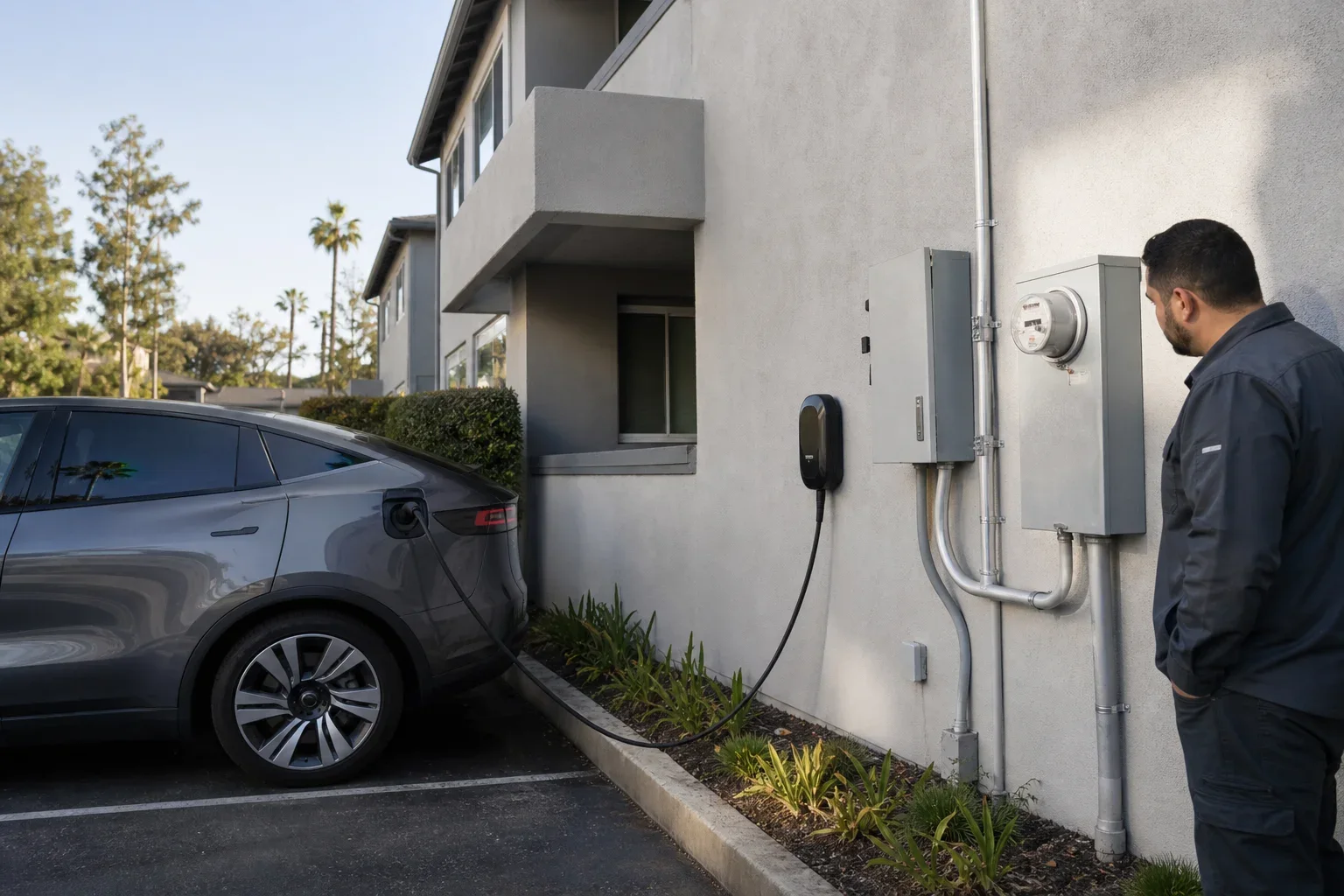
Do not approve a proposed installation based only on a charger model or a contractor’s verbal estimate. Require a site assessment by a licensed electrical contractor. The assessment should address:
- Main service size, panel capacity, subpanels, disconnects, and existing electrical loads.
- Whether a dedicated circuit, load-management system, panel upgrade, transformer work, trenching, or utility coordination is necessary.
- Distance from the electrical equipment to the parking space, wall or pavement conditions, drainage, lighting, and protection from vehicle impact.
- Whether the proposed equipment is listed for its intended location and installed according to applicable electrical requirements.
- Accessible routes, stall dimensions, visibility, cable placement, and whether the layout creates a trip or vehicle hazard.
A Level 1 outlet may be practical in some single-family rentals, while a Level 2 charger may require substantial infrastructure in an older Los Angeles or San Fernando Valley building. The correct solution depends on the property’s actual load and layout, not the vehicle owner’s preferred charging speed.
Confirm Permits, HOA Rules, and Responsibility
Electrical permits and local approvals should be identified before work begins. In the City of Los Angeles, LADBS provides an online permitting pathway for electric-vehicle charging stations. Other jurisdictions, including Burbank, Glendale, and nearby Valley cities, may use different procedures. The contractor should identify the permitting authority and provide permit documentation, final inspection records, and equipment information to the owner.
For condominiums and common-interest developments, coordinate with the HOA before scheduling work. Civil Code Section 4745 addresses unreasonable restrictions, architectural review, written decisions, licensed contractors, insurance, electricity, maintenance, and restoration obligations. A property manager should not promise approval before reviewing the declaration, parking designation, architectural rules, electrical ownership, and HOA application process.
Use a written agreement that identifies who owns the charger, who owns wiring and panel improvements, and what happens when the renter moves. The agreement should address removal, restoration, abandoned equipment, access for repairs, damage to common areas, and whether a future renter may use the installation.
Set the Cost and Insurance Terms Clearly
Charging creates costs beyond the equipment itself. The approval package should state how the parties will handle:
- Charger, wiring, labor, permits, engineering, trenching, utility work, and panel upgrades.
- Electricity, including whether usage is separately metered, billed through a networked charger, estimated, or added through a documented rent arrangement.
- Maintenance, software subscriptions, repairs, replacement, vandalism, and damage caused by installation or operation.
- Insurance, indemnity language, contractor coverage, and any required certificate of insurance.
California’s residential charging rules place many installation, electricity, maintenance, repair, removal, and damage costs on the renter when the renter installs the station. Insurance requirements can depend on the equipment, installation method, lease terms, and whether a condominium association is involved. Owners should confirm the requirements with their insurer and legal counsel rather than relying on a generic waiver.
Put the Decision Into the Lease File
A consistent approval workflow helps protect both the owner and renter. Ask the renter to submit a written request with the parking-space identification, charger specifications, contractor license information, scope of work, plans or photos, electrical assessment, permit plan, cost allocation, and proposed insurance documentation.
Before work starts, provide written approval, conditional approval, or a legally supported denial. Do not allow installation based on a text message or informal conversation. After completion, retain permits, inspection approvals, invoices, photographs, warranties, equipment serial numbers, and the signed responsibility agreement.
For owners, the next step is a property-specific review of parking control, electrical capacity, insurance requirements, and HOA or municipal procedures. For renters, submit a complete proposal and be prepared to pay the installation and ongoing costs assigned to you. A careful process can support EV access without leaving unclear liability, billing, or maintenance obligations behind.
For broader residential property management support, owners can use a documented maintenance and compliance workflow that keeps alterations, vendors, and renter communications organized.